
Planning for the Future of the Webster Groves Public Library: Proposition L
For generations, the Webster Groves Public Library has been a place for learning, connection, opportunity, and community. From early literacy and technology access to outreach, public spaces, and lifelong learning, the Library serves thousands of residents every year.
As the Library looks ahead, rising costs, aging infrastructure, and the partial expiration of a temporary levy in 2029 create financial challenges that require long-term planning today.
With Proposition L, the Library is requesting a 12-cent increase in its property tax levy.
The proposed funding increase would help the Library maintain essential services, protect and improve its historic facility, and create a sustainable financial foundation for the future — ensuring the Library remains a strong, welcoming resource for generations to come.
Please check out the information below to learn more about Proposition L.
What is Proposition L?
Proposition L is a funding proposal designed to protect library services, maintain the Library’s historic facility, and ensure long-term financial stability for the Webster Groves Public Library.
The proposal would approve a 12-cent increase in the Library’s tax levy per $100 of assessed valuation. The Library has not received additional operating support through a tax levy increase in more than 17 years. The last increase, approved in 2009, was a temporary 20-year levy that partially expires in 2029.
With rising operating costs and increasing building maintenance needs, the Library is planning ahead to avoid future budget shortfalls and continue providing the services, programs, and resources the Webster Groves community relies on every day.
Proposition L is focused on responsible long-term planning to preserve and improve a vital community resource for generations to come.
Why is the Library asking for this funding now?
The Library is planning ahead to maintain services and care for its historic building well into the future. The need is driven by several key factors:
- Rising costs over time – The Library has not asked for a funding increase for over 17 years. Yet like households and businesses, the Library is experiencing higher costs due to inflation. This includes increases in utilities, materials, maintenance, staffing, technology, and the cost of books and e-resources.
- An expiring tax levy – A twenty-year temporary tax levy approved by voters in 2009 will partially expire in 2029. When the levy expires, the Library’s available funding will decrease significantly, creating projected budget deficits without a long-term funding solution.
- An aging building that requires ongoing investment – The facility includes areas that are over 75 years old, along with newer sections (going on 15 years old) that are beginning to require more maintenance and updates.
- Reserves have been used strategically for major capital needs – Just this year, over $500,000 was spent on replacing the building’s heating and cooling system. Other large-scale projects are still ahead, which highlights both the scale of building needs and the reality that reserves alone are not a sustainable long-term solution for major repairs.
- Property tax dynamics in Missouri, including limitations imposed by the Hancock Amendment, can limit how quickly revenues generated by tax levies grow over time.
Without a long-term funding plan, annual operating costs would exceed annual revenue, leaving no room for building improvements or major repairs.
This proposal ensures the Library can continue serving the community seamlessly and without disruption. It will enable the Library to plan responsibly for the future.
What are the Library’s sources of funding?
The Library receives almost 90 percent of its funding through a voter-approved property tax levy. Property taxes are the main source of funding for most public libraries in Missouri.
Additional sources include:
- State funding (limited and often program-specific)
- Grants for special projects and services
- Passport service revenue
- Donations and Friends of the Library support
- Interest income
While helpful, these additional sources make up only 8.4% of the overall budget.
Because the Library relies primarily on property taxes:
- Funding is determined locally by voters
- Revenue grows gradually based on property values
- Funds are dedicated specifically to Library services
This structure ensures that Library funding is stable, locally controlled, and dedicated entirely to serving the community.
Why isn’t the current funding enough?
The Library’s current funding structure is more than 17 years old and is not designed to meet today’s operating costs and long-term building maintenance needs. In addition, a temporary voter-approved levy will partially expire in 2029, significantly reducing available revenue at a time when costs continue to rise.
While the Library has responsibly used reserves to address major repairs—such as this year’s $500,000 HVAC replacement—those funds are limited and cannot sustainably support ongoing operations and future capital needs. Without additional funding, annual operating costs are projected to exceed annual revenue creating ongoing budget deficits.
As a result, the Library would face increasingly difficult decisions regarding services, staffing, collections, technology, building maintenance, and future repairs. Proposition L is intended to address these challenges before they become crises, allowing the Library to continue serving the community while responsibly planning for the future.
How will this levy impact taxpayers?
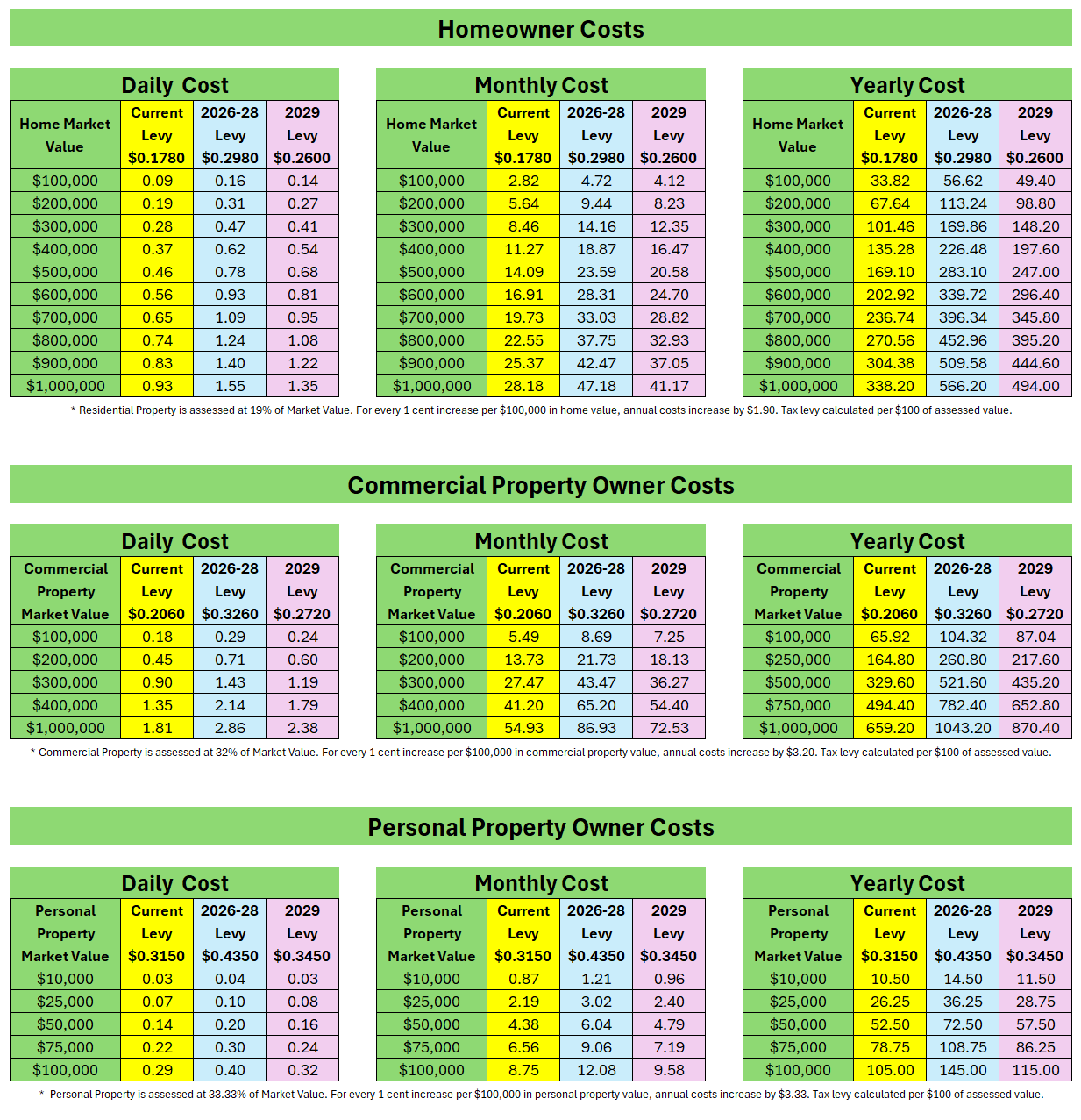
The Library is asking voters to approve a 12-cent property tax levy increase per $100 of assessed valuation. The tables below show the estimated daily, monthly, and yearly cost for homeowners, commercial properties, and personal property owners.
In the columns below, yellow represents costs under the current tax rate. Blue shows costs during a three year “overlap” period of 2026-2028, before partial rate expiration provisions of the 2009 tax levy take effect. The pink column represents costs beginning in 2029 with the approval of the new tax levy with the 2009 levy having partially expired.
Click the chart to view at full size.
What is the projected revenue with and without the levy increase?
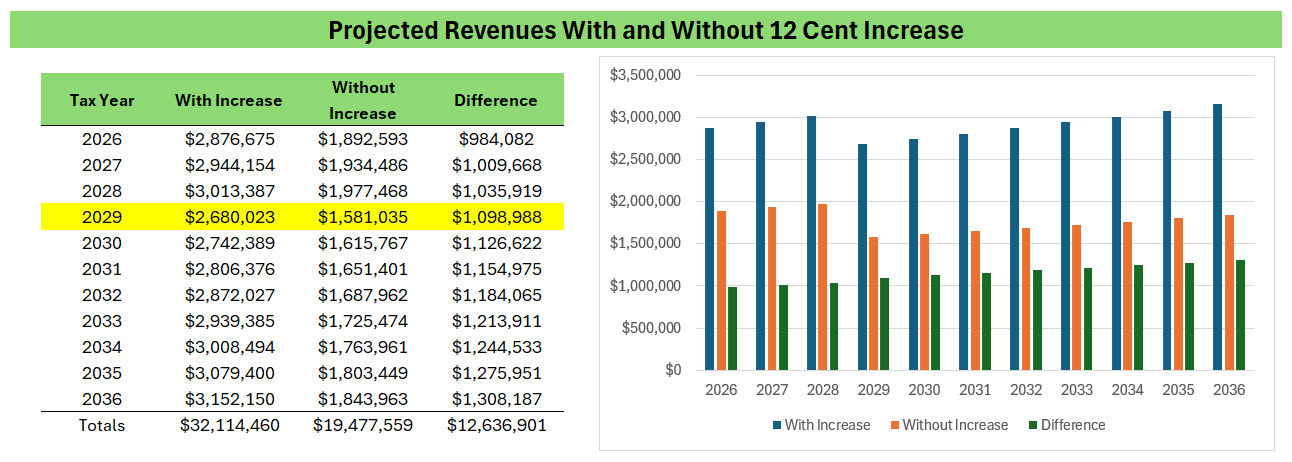
The table below shows projected revenue with and without the levy increase. 2029 is highlighted as that is the year the temporary levy partially expires.
Click the chart to view at full size.
Why is the temporary levy ending?
In 2009, Webster Groves voters approved a temporary property tax increase created to support renovating, improving, operating, and maintaining the Library. The temporary increase was approved with a 20-year sunset provision, meaning a significant portion of the tax rate was designed to automatically expire in 2029.
This measure allowed the Library to complete its major renovation and building addition in 2012. The proposal increased the Library’s tax rate by $0.135 per $100 of assessed valuation, with the rate scheduled to automatically decrease to $0.045 per $100 of assessed valuation after the 20-year period ends.
What will happen over time?
2026–2028 Levy:
The current temporary levy remains in place while the newly approved levy would also begin, creating a temporary three-year increase in revenue.
2029 Levy and Beyond:
The temporary levy reduces as originally approved by voters, bringing total revenue down from the peak overlap years but still above today’s funding level.
Why not wait until 2029?
Planning ahead allows the Library to:
- Avoid a sudden funding drop, deficit spending and potential service impacts
- Plan major projects responsibly
- Spread costs over time
- Maintain stable services
Waiting would limit options and could lead to more costly, reactive decisions.
How will the funds be used?
Funds will support both operations and the building.
Operations: Funds the daily operations and core public services of the Library, including staffing, collections, programming, technology, outreach, and community service resources.
Building & Infrastructure: Supports facility repairs, safety improvements, ongoing maintenance, and space enhancements, including roof, plumbing, electrical, flooring, and updated public areas such as children’s spaces and lower-level study rooms.
These investments ensure the Library remains a safe, well-maintained, and fully functional community cornerstone—welcoming, reliable, and equipped to serve residents for years to come.
What services does the Library provide?
The Library provides essential, everyday services that support learning, connection, and opportunity for the entire community.
These include:
- A safe, welcoming place for people of all ages to spend time, connect, and learn
- Access to hundreds of thousands of books, materials, and digital resources
- Outreach services (bringing Library services to senior living communities, homebound residents, schools, and community organizations)
- Free Wi-Fi, public computers, and technology assistance
- Community meeting and gathering space for residents, nonprofits, businesses and other local groups
- Community partnerships, local events, and public programs
- Early literacy and educational programs for all ages
- Job support, research help, and one-on-one assistance
Year after year the Library delivers significant value to Webster Groves residents. For example, in 2025 alone we recorded:
- 274,867 items borrowed
- 250+ programs for youth and adults with over 4,000 attendees
- 291 community meetings hosted
- 157 outreach visits across the community
- 5,338 public computer sessions and over 30,000 Wi-Fi sessions
- 1,600+ passport applications processed
- Specialized services like hundreds of VHS home movies digitized, dozens of house history and other local history research projects, dozens of other Book-a-Librarian support sessions, and low-cost or free printing/scanning/faxing services
The Library’s role in the community is defined in other ways:
- A polling place supporting local elections
- A Safe Place for youth in crisis
- A hub for community support, including food drives and local partnerships
- A space for local art and community exhibits throughout the year
And of course by its people:
- A friendly, knowledgeable staff that is engaging, approachable, and ready to help everyone who walks through the doors
These are not extras—they are essential services that people rely on every day.
How is the Library being financially responsible?
The Library takes a proactive, long-term approach to managing public funds.
This includes:
- Planning ahead for known funding changes, including the partial expiration of the temporary levy in 2029
- Using reserves strategically without relying on them for ongoing operations
- Avoiding placing ourselves in a position where annual operating costs would exceed annual revenue
- Phasing maintenance and capital projects to avoid large, sudden costs
- Evaluating tools like long-term financing, when appropriate, to spread costs responsibly
- Maintaining regular financial oversight through monthly review of revenues, expenditures, and budget performance by the Webster Groves Public Library Board of Trustees
- Conducting an independent annual financial audit to ensure accountability, transparency, and compliance with public finance standards
Looking ahead, the Library is planning for key investments such as:
- Roof replacement
- Drainage and plumbing improvements
- Tuckpointing to maintain the building’s structure
- Improvements to accessibility and overall functionality of the space
By planning ahead, these needs can be addressed and then maintained responsibly, protecting services while ensuring the building remains safe, functional, and welcoming.
This approach helps minimize unexpected costs, supports day-to-day operations, and reflects careful stewardship of a valued community asset.
What is the long-term goal?
The long-term goal is to ensure the Library remains a vital part of the Webster Groves community, one that people rely on every day and are proud to have.
This means:
- Maintaining the high-quality services residents already use and value
- Caring for and improving the Library building so it remains safe, welcoming, and functional
- Continuing to expand programs, outreach, and resources to meet evolving community needs
- Ensuring the Library can serve all ages, from young children to seniors, for years to come
The Library is more than a building; it is a place for connection, learning, and support. This proposal ensures it can continue to grow, adapt, and respond to the community while maintaining the strong foundation it has today.
It is about investing in a Library that not only serves the community now, but continues to be a trusted, welcoming, and essential part of Webster Groves for generations.
What is the ballot language for Proposition L?
Shall the City of Webster Groves Municipal Library District increase its tax levy by $0.12 per $100 of assessed valuation to operate, maintain, and improve the library building and grounds; strengthen programs and services for all ages; fund general library operations and staffing, and ensure the library’s long-term financial viability? If this proposition is approved, the total levy of the Library per $100 of assessed valuation is estimated to be $0.215 for residential property, $0.227 for commercial property and $0.300 for personal property.
These figures are based on adding 12 cents to the Library’s current tax levy rate. The tax impact tables under “How Will This Levy Impact Taxpayers?” reflect the proposed total levy rate during the overlap years. Beginning in 2029, the rate reflects the expiration of a portion of the 2009 temporary levy, with the remaining 4.5 cents continuing as part of the Library’s permanent levy rate.
How is the Library Connected with the City of Webster Groves Municipal Government?
The Library is an independent taxpayer-supported governmental organization similar to a school district.
The Library has:
- Its own voter-approved tax levy, with funding dedicated specifically to Library operations, services, and facilities
- Its own budget and financial structure, receiving no direct financial support from City Hall, while City Hall receives none of the funding generated by the Library’s tax levy
- Its own Employer Identification Number (EIN)
- An independent Board of Trustees that sets policy, approves the Library’s budget, and provides oversight and governance
- A Library Director who manages day-to-day operations and reports directly to the Board of Trustees
- A professional staff hired and supervised by the Library Director
Where does the City of Webster Groves Municipal Government come in?
- The Library Board of Trustees is independent, but Board members are appointed by the Webster Groves City Council after applying to serve
- The City formally sets the Library’s tax rate each year based on the voter-approved levy
- The Library participates in the City’s employee benefits program for full-time staff, with the Library fully reimbursing the City for those costs
The Webster Groves Public Library is also separate from the St. Louis County Library system. Webster Groves residents do not pay property taxes to support the St. Louis County Library. Taxes generated through the Webster Groves Public Library levy stay in Webster Groves and directly support your hometown Library.
What happens if this proposal does not pass?
If no action is taken:
- Funding will decrease in 2029 when the temporary levy partially sunsets
- Annual operating costs would exceed annual revenue
- The Library will have limited ability to maintain or improve its building
- Major repairs may be delayed or handled reactively
- Reserves would be used until depleted
Over time, this would lead to difficult decisions about:
- Service levels and hours
- Programs and outreach
- Building maintenance and accessibility